Monday, July 3, 2017

Swan Song

By Alessia Ulfe

It has been a couple of days since the end of Peace Lab and almost ten days since we came back from Kosovo. The same amount of time we spent in Kosovo. Yet, this ten days in Amsterdam haven’t been as exciting or have had the same impact in my life as the days in Kosovo have.  Even though peace lab finished and I have had days to write this blog post, maybe subconsciously I knew that this blog post would mean the end and I just did not want the end to come. The end of Peace Lab also means space for reminiscing about the good times and thinking about how much this month has changed me.
Newborn Boulevard, Prishtina, 2017

After coming back from Kosovo and having time to process everything that happened, we had to present our projects. This made us relive the trip, by sharing anecdotes of how our work proceeded. Personally, my project taught me to, as Anne calls it, “trust the process”. Initially, Klaudia and I went into the trip with a set idea of what we were looking for and we had a plan. Yet, it only made me realise how naive we were. We had no idea of what we were going to encounter and had to go with the flow of things. Trusting the process is something that can be scary as you do not know what to expect. I like knowing what is coming next, yet this month has shown me that sometimes you cannot control everything around you. You cannot control the field and you may just need to take a leap of faith and trust that there is going to be an outcome. The outcome of my project- a policy brief for the Kosovar government regarding bilingualism in schools, makes me incredibly happy to have trusted the process. With Klaudia, we would have never arrived at that topic if we had not kept on interviewing people and going around asking why.
Anne and Erik, Gazivoda Lake, 2017

This month was full of surprises and something that has left an impression on my mind was how easily and willing people were to share their stories. We live in a rather individualistic society, where sometimes it is better to keep your life story, and what you have been through to yourself. Yet in Kosovo, everyone was willing to tell you their story, and you could see how just by lending a listening ear their pain was eased. This was the least effort we could give to our hosts, to just listen and try and understand. Understand where they are coming from to understand where they are going, their motivations and dreams. In a society where everyone is carrying pain, being able to be part of their relief system was truly special. Not only that, it brought everything that we learned in class much closer to home. The conflicts and statistics ceased to be part of the one week of Balkan history, it became real. Especially the statistics, they became someone’s uncle, cousin or sibling. The story-sharers are the ones that have changed me the most. It is their courage, honesty and drive that has (and probably will forever) leave a mark on me.
The view from the Kalaja, Prizren 2017


For this last blog post, the prompt was “What have you learned? or How have you changed” yet I do not think it is fair to ask us this. At least for me, it has been such a sublime experience that verbalizing it (even on paper) makes it lose its secretive touch. This has been between Kosovo and me, and what we have shared, how I have changed, and all of those other things will always remain in my heart.
Sanne at the Lake, Kosovo 2017


x

Celebrate the differences, and the things in common!

By Ilen Madhavji

So this course started with a lot of reading and learning. Primarily this was about the history and conflict that plagued Kosovo and the surrounding Balkan region. As Albin Kurti (the prime minister candidate for the Vetevendosje party in Kosovo) would put it, this forced us to look through "ethnic lenses". As a result, we saw Serbs vs. Kosovars, Albanians vs. Serbs, and all the other ethnic divides in the region. In addition to this, we learnt about all the differences between these groups of people, and the differences that caused splits even within these groups of people. This created an impression of Kosovo that I took with me when we first arrived.

In my mind, Kosovo was an angry nation comprised of ethnic groups that were angry with each other all the time. Although there is considerable tension between people there, I could not have been more wrong about what Kosovo is like. The moment I truly realized this was after Tom, Giacomo, and I had completed our documentary (Kosovo and the EU: A Matter of Perspective) and we could fully take in the message that we were trying to send. Our film is about the past, present, and future of EU involvement in Kosovo and in order to create it we had to interview many diverse people on this multifaceted topic. What quickly came to our attention was that everyone has got something different to say about the EU and what their influence has been on the region. These opinions can vary from very negative to very positive. Also, what was interesting is that these differences of opinion were also to be found within one nationality of people. So, even after doing all these interview of people who held different positions within society, I was still seeing Kosovo and a collection of people who have differences and in a way that became a big part of my definition of Kosovo.

Upon returning, we finished our documentary and once I had seen it for the first time in full it hit me: everyone was talking about their differences, but the things in common were present in other forms. A great example to illustrate this is actually visible in our documentary. As mentioned previously, there are so many varying opinions on the EU but what I did not initially notice is that once the conversation veered towards the future, everyone imagines it including EU membership and the benefits it would bring. The reason for this is that they ALL want to live a good life in a country with a prosperous economy, good schools, visa liberalization, and opportunities for their children. These wishes supersede boundaries and nationalities, and they see EU membership as the main vehicle that can kickstart this.

Looking back at this now, they are not at all that different from each other, and I hope this is something that all the people in Kosovo can achieve together with the EU and other organizations.

Time to process...

By Tom Vrolijk
  
While writing this blogpost, I started thinking back on the past couple of weeks. Only now that the dust has settled, and I have been able to put my mind to rest for a couple of days, has everything we saw, did and learned started to really sink in. For many of us this trip has been a special trip to say the least. It is annoyingly difficult to explain to people what exactly has been so ‘eye opening’ about this trip, and what exactly the shocking, or special things we saw were. Yet, in these blogposts we will try to explain, and try to make people understand.

For me, personally, Kosovo has an incredible learning experience, yet I still have trouble pinpointing exactly what I leaned. From day one onwards you notice Kosovo is not like any other country. All of us knew we were not there for holidays, yet that became more clear to me after our very first interview. Two other friends and I interviewed a student at the University of Prishtina, and she opened up to us completely. She told us about her grievances from the war, and about future hopes. Once people start opening up to you, you begin to see their side of the problem. Every time you would hear another perspective on the war, or other issues. When you talk to so many different people about the same topic, in our case Kosovo and the European Union, you start to notice the small things. Some things people say might seem insignificant at first, but once you look at the whole story, and once you see the whole ‘picture’, then these motivations or thoughts end up being key. Many people had good hopes for the future of Kosovo and the EU, and every single one of the people we talked to had different, yet similar reasons. They all wanted a better future, both for them and for the next generation.

Talking about the future, I believe Kosovo has a bright one coming. I hope Kosovo will be able to get over its internal problems soon, and will be able to focus on other prevailing issues such as joining the EU, promoting certain rights and much more. Since I have been so involved with Kosovo and the EU, it has been on my mind a lot. For Kosovo to join the EU there are two conditions, they need to tackle corruption, and there needs to be a demarcation of the border with Montenegro. The issue of corruption is very controversial in my opinion. The EU mission in Kosovo is supposed to help clear corruption, in which they are not succeeding, yet they still demand of Kosovo to tackle corruption before being able to enter. If the EULEX mission would be more effective, Kosovo might not have this problem, and might already be in the EU.

I have caught myself being Pro-Kosovo in many regards, and rightfully so. For example, I think the EU is at fault and not Kosovo, I think Kosovo should be recognized by both the UN and the EU and I think Kosovo deserves a chance in the world, which they are not getting right now. Because of this trip I have realized how amazing this country is, and what it has to offer. I have also seen what kind of particular situation they are in, and that it is will be difficult to get over the past grievances and build now connections. Yet, luckily there are many organizations who work hard to bring Kosovo back on track, and connect the people again.
(In Prizren with our host Enver)

On a more personal note, I have learned to trust. As Anne would say, “Trust the process”, and she was right. The process, which starts day one of Peace lab, and unfortunately ends as I am writing this blogpost, has been amazing. Day one made me realize this place (Kosovo) was special, but the whole month in total has made me realize the whole process is special. Throughout the 10 days in Kosovo, we had a busy schedule, and often did not have time to process what we saw, or did. This realization has only hit me after the last class finished last Friday. It was that evening that I realized what an amazing month I had just had. To name only some of the things I thought about: We met amazing people, of which the highlight was Enver, our host and friend, we saw firsthand how the peace building process works, we saw how people opened up and told us their hopes and dreams about the future, and most importantly, I hope with our documentary (Online soon) we can inform more people about Kosovo and in that way, help Kosovo in any way possible. Kosovo has left its mark on me and on how I see certain issues. I am sure I have not completely processed everything yet, but that needs time, and that’s exactly what I have right now, two months of time.

Sunday, July 2, 2017

How was Kosovo?


By Dania Elahi

The past few weeks have been intense – with a lot of learning practically and theoretically. The first week started off with the crash course of the Balkan history, trying to get familiar with what we would have to know when in Kosovo. It was an intense week for me, as I had no knowledge on the history of the Balkans, but more of a generalized view. Weeks two and three were spent in Kosovo, going to different organizations and NGOs, spending time in a completely non-academic environment. Our last week comprised of all the projects we had focused on when in Kosovo, which included topics on gender, alcohol and food as peace-building tools, and a documentary on the EU and Kosovo, among other things.

“How was Kosovo?” was a question that was asked right after we had gotten back from our memorable trip. Friends and family asked about how it was, and what we had done. However, it was just so difficult to answer and to condense the whole experience we had into a few lines, or even just into words. There were all the experiences we encountered, the organizations we met up with and the people we conversed with. It was all a very memorable and an overwhelming experience. Even now, looking back, it is such a mix of emotions, as we went there with an open mind, and came back with more information and opinions that I thought I would have. I learnt that the kind of learning you get in the field is nothing compared to the learning you have in the classroom setting, which was evident everyday that were there. Moreover, the one thing I did learn was how to listen and let people just talk, during the interviews. The more you talked to them, not just about the war or their history, but more general topics, the more they opened up, and talked about something sensitive. 

One aspect that was very admirable was the amount of hospitality that strangers showed. Be it on the streets or with our host families; people always tried to show us around. But also, how peacebuilding is not a black-and-white topic. There are so many factors that go into this, more than that, you need time, a lot of time, and a lot of patience, to get to some place which would somehow be ‘peace’. 

Furthermore, I come back with more friends from both our AUC class that was on the trip, but also the individuals we met in Kosovo throughout our days there, with the host families taking us in and the interviewees we ended up staying in touch with. All the memories will always be cherished. But finally, a special thanks to Anne and Erik for everything.

Us with our host family

Saturday, July 1, 2017

Nostalgia


By Layla Gegout

Today is the first day after the end of our Peace Lab class. Although we all expected to feel free, happy and relieved to be on a break, I think the most prominent feeling among the students in the class is that of nostalgia. The past week was spent working hard on our group projects, and none of us have had the time to properly sit down and recover from our trip to the Balkans, so today is the first day that we are all able to take a breather and reflect on our experiences.

Dania and Julia in Prizren

All the different group projects that were presented in the past week have illustrated the vast array of things we learnt while in Kosovo. Gender inequality, ambiguous feelings towards the involvement of the international community, food and alcohol as peace-building tools, the importance of language, wishes for the future… All these presentations threw us back into our Kosovar mindset and allowed us to recall everything we’d witnessed. Because of this, a feeling of nostalgia has slowly but surely crept its way into each one of us (or maybe I’m just generalising my feelings to the whole class?) which came to its culminating point yesterday as we said goodbye as we were leaving the classroom. As some of us are third years, yesterday marked the very last day of our AUC academic career, and for others it was a matter of saying goodbye for a few months. Despite promising each other we would stay in touch and meet up regularly, there was an overpowering feeling of something coming to a dramatic end, as it was understood that we would never find ourselves in the same group, under the same circumstances and with the same dynamics as we’d been in for the past month.
In his presentation, Ilen mentioned that the most interesting thing he had discovered through making his documentary with his group about Kosovo and the European Union involvement, had been the apparent lack of attachment with the present that Kosovars have. By this, he meant that he had observed their tendency to anchor themselves to a memory, tensions or history from the past, or on the contrary, to their way of looking at the future in an optimistic way as a solution to their current problems. He contrasted this mindset to a more Western perspective of being able to have a stable grip on the present, separately from the past or the future. However, reflecting on this past month, I realise that I - and probably most people around me - tend to live in the past, dwell on memories of good times that will never return or regret things that did not happen, instead of enjoying the present moment. This is therefore a good opportunity to practice using what we’ve experienced in Peace Lab and applying it in a positive and constructive way to build on my present-day life, without going into a full-fledged emotionally-packed sob story about what I am going to miss in the future.


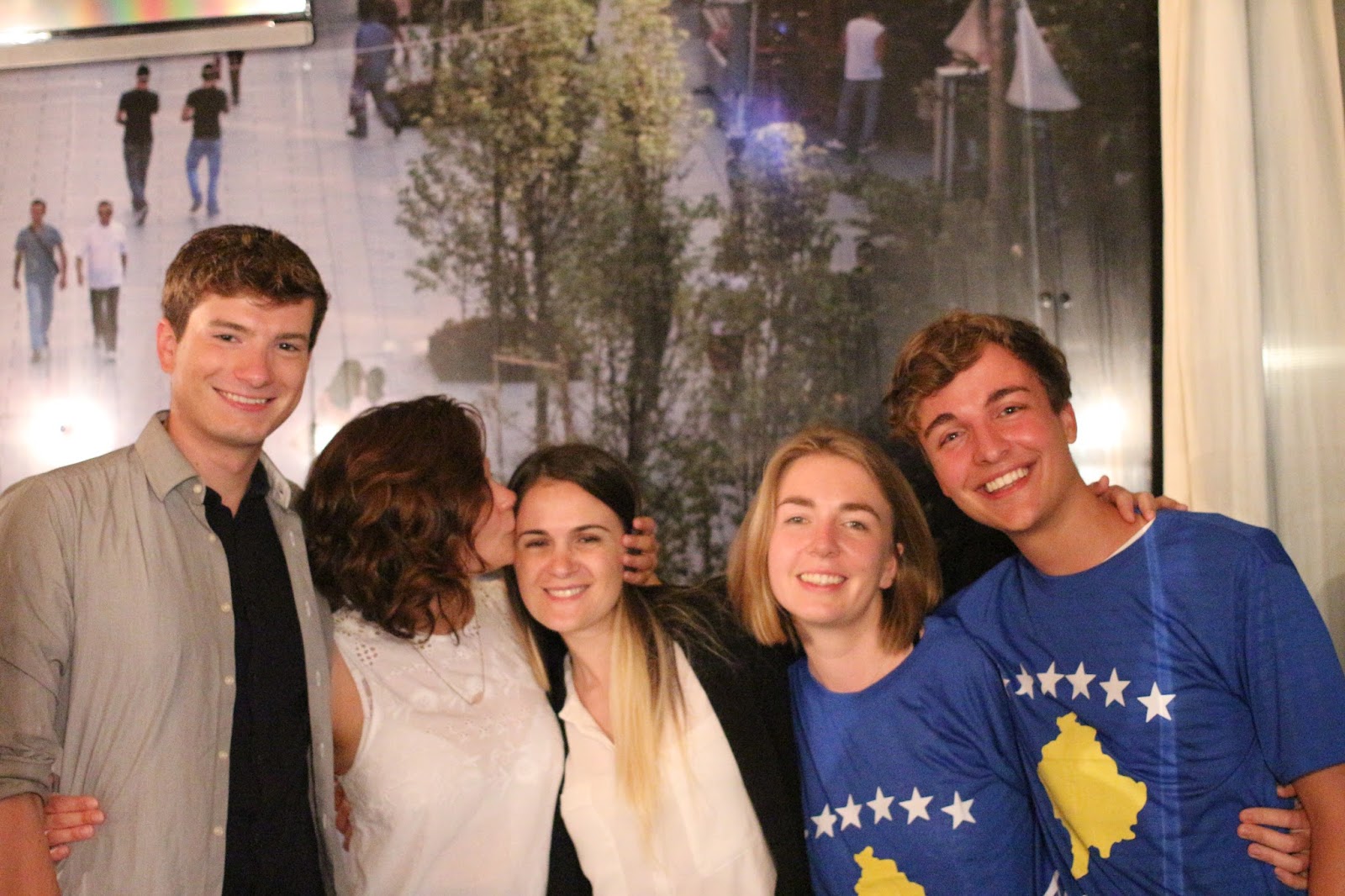
Our last night in Kosovo

These are the main things I have learnt during the past month:
  • From an academic point of view, our peace lab experience has given us practical tools and tips and tricks to carry out (relatively) successful interviews. If you want to judge how well we did, you can have a look at our group project ‘Voices of Kosovo’ on Facebook, in which we aimed at painting a bottom-up picture of the Kosovar society by giving a voice to the average citizen and asking about their hopes and dreams for the future.

  • Kosovo has taught us to trust strangers, as we were living with individuals and families we’d never met before. We also learnt to trust in the kindness of strangers, and that people are often willing to open up and talk about their stories, experiences and points of view, they’re just waiting to be asked.

  • Through this class we all created new friendships, both with Kosovars and with AUC students with whom we may have crossed paths on a daily basis prior to this class, but we never necessarily took the time to properly interact with. This kind of bonding experience truly teaches you to open up and trust that most people are good-hearted and kind.

It’s now time to pack our bags and return to our respective homes, where we will definitely miss Anne’s ‘Annisms’, Erik’s tasty food and Robbert’s tourist-guide skills, but at least we’ll be able to use the unique and enriching experience that was the peace lab course.

Peppi dragging her whole life around in these two suitcases


We Have Crossed the Bridge

By Sanne de Schipper
 
Yesterday was officially the last day of Peace Lab, and for some even the last day of AUC, even though some of us still have to hand in some papers ;). For me it was the last day of Peace Lab, the last day of AUC and the last day of living in the dorms (also why my blog is late because I was moving yesterday, my apologies!). When I was packing all my stuff, I realized that I have a lot more stuff than I initially thought. I think that this is also true for Kosovo, even though we did not take an extra suitcase of stuff home, we did learn a lot more than anyone had ever expected.

We learned about the history of the Balkans in the first week, which seems like a lifetime ago; and in the second and third weeks we learned more about the people, the country and the different perspectives; and this last week we learned from each other. Every group presented their project during the final three days of the semester and I have to say that I was very impressed by every single one of them. We have seen a documentary, an art exhibition, listened to a podcast, but we also ate flija (Robbert, Dania and I attempted to make this traditional Kosovar dish, it tasted pretty good but it did not look like the flija we had in Kosovo ;))  and drank raki. Every project looked at peace building through another lens and I learned something new during every presentation.

I also learned a lot personally and to illustrate this I like to tell two stories about my time in Kosovo. The first story I would like to share with you took place in North-Mitrovica, which is a so called Serb enclave. We (Robbert, Dania, Nora, Klaudia and I) were walking around on the main street and Nora saw that there was a line in front of the bank. So she decided to ask the people what was going on and use that for her project, The Voices of Kosovo (check out their amazing Facebook page). She ended up talking to a student from Montenegro and they were talking for a while, so the rest of the group decided to join the conversation. We had a real nice conversation about Kosovo, his struggles and his dreams. Since it was lunch time, we asked him if he knew a good place to get some food. He knew a nice place and he would walk there with us, once we were at the restaurant we asked him where he and his friend who joined were going. They answered that they were going to the student cafeteria, so we asked if we could come, just to see what it was like. So together we walked to the cafeteria and the guys ended up arranging a free lunch for us. The canteen ladies responded that “if you are here all the way from Amsterdam, you cannot leave without food”. For me this was such an amazing experience, because a couple of random people come up to you to ask you some questions and instead of responding a bit annoyed (which usually happens in The Netherlands), you invite them to come eat with you. Not only did they arrange food for us, but they also opened up to us; telling about their lives, their dreams and their hopes for the future. We had such a nice time and it was sad that we only had a limited time there, before we had to go to our next meeting.

In front of the cafeteria

Something similar happened when Robbert, Dania and I went to the National Library in Pristina. We were there just to have a look at the building and see the inside. However when we entered the building almost everyone was staring at us. So we decided to approach one of these groups of staring men and ask them some questions for our project. We ended up having a great conversation about an hour and a half with two of the guys. They gave us a tour through the library, shared jokes, we talked about our countries, traveling and Kosovo. It was again so surprising to me that people opened up so much to ‘strangers’. I learned so much from this, because I am more of an introvert person, so it was very nice to talk to these people and share stories. Even though approaching strangers was a bit difficult for me from time to time, every conversation we had was so nice and it made me open up a little too!

In front of the library 


This experience has changed me and I think all of us, and as Anne said “we have all crossed the bridge”. 

Trusting the process, spending time with the youth and faith for the future

By Rachael Liss

During the trip I really let go of everything related to stress and AUC work and just tried to take everything in as much as I could, and, as Anne always says ‘trust the process’ – there couldn’t have been any better advice! Spending ten days in a new place might not seem like such a long time but we met so many people and experienced so much in this time, I feel like I have lived in Kosovo for years and the city of Pristina feels like a second home. If I had done anything else than just sit back and ‘trust the process’ I think I would have exploded or gone crazy! There is simply much too much to take in to be worried about trying to understand it all or make sense of it all or organise it all …. So, even though it felt unnatural at first to not try and organise and structure everything that was happening to me (as I usually do), I let myself go with the flow and enjoy all of the craziness.

I have to be honest, I ‘partied’ a lot more in Kosovo than I had expected to…. But going out and spending time with the young Kosovars was eye opening and really helped bring another side of the country to light – it was a perfect addition to the more academic/serious aspect we got from all of the international organisations, where we kept talking about the problems in Kosovo like unemployment and visa liberalisation and segregation of communities – going out with young people just showed me how ‘normal’ a place Kosovo was! We do all the same things back home on a night out as Kosovars do! And we didn’t spend the evening talking about how frustrated they were with their country or how some people hate one another… we just drank and laughed and danced! and I think this is really important for people to understand: on the rare occasions when Kosovo is mentioned in the news or on social media, it is usually portrayed in a typical western perspective of an unstable post-conflict society with huge issues of ethnic hatred and a bad economy – what they don’t see is what my friends and I were able to see when spending so much time with these people and becoming friends with them: they are literally just like us!

I was thinking about what advice I could give to Kosovo, and of course, it is much easier said than done and, of course, it is much easier for an outsider to come in and pin point the issues… However, I felt like sharing a couple of my thoughts with everyone: 

I know it is difficult, and history and the past are a huge part of one’s identity, BUT I believe that reconciliation cannot fully take place until people forgive and let go of what happened in the past. At the end of the day, the people we spoke to all wanted the exact same thing, whether they were Kosovar Serbs or Kosovar Albanians, women or men, Roma or LGBTI: to live in a peaceful and prosperous Kosovo. The only way this will be achieved is if people work together and put their differences behind them. One of the main things that kept coming up all over Kosovo was the issue of unemployment. SO, a priority for the country should be employment! When you are unemployed, you get bored and frustrated; with frustration, you want someone else to blame for what you are going through and it is just so easy to point fingers at each other, and eventually, frustrations can even lead to violence.

I have so much faith in Kosovo: mainly due to the huge young population that we got to spend so much time with. Everyone we spoke to during the interviews we conducted were so full of energy and enthusiasm and all stated that they were willing to become friends with the ‘other’. They are willing to take the steps, but the issue is that there is no place for these two groups to come together as they are not integrated together in society – this needs to be changed! At the moment there are two systems: these systems need to be moulded into one. They will not stop seeing each other as ‘others’ if they are not actually integrated into one, into the same. When people cooperate and start to share common stakes and interests, they start seeing eye to eye.

Things will get better, this takes time, like all good things in life, and with time comes peace and forgiveness. And I believe it is in the hands of the youth to bring forward this change.