Tuesday, June 20, 2023

Peace privilege

By Mara Smelt


After a hectic first day we woke up on Thursday (15 June) morning with renewed energy and excitement. Where the Wednesday had felt like a jump into the cold water, we now knew what to expect and how to prepare. Surprisingly enough, sharing two showers with twenty people has been a relatively smooth process and so at 9:15, after a quick shower and run to the nearby bakery, we made our way down to the NEWBORN monument again. Our Thursday morning walk was cold and wet but this could certainly not spoil our excitement for the upcoming meeting and so, equipped with umbrellas and raincoats, we arrived at the office of our next appointment: Zana Hoxha. 

Hoxha is a Kosovar feminist artist, performer, theatre director, and advocate for women’s rights. Based in Prishtina, she has, among other achievements, managed to set up the yearly artistic festival FemArt, which has become a platform for feminist performers across the Balkan region and far beyond it. Working from the idea that the arts can be a tool to change the narrative, initiate discussions, and foster societal improvement, Hoxha’s FemArt brings together feminist performers from all across the world. 


At Zana Hoxha's office

Upon entering Hoxha’s office we were aware of her background and achievements, yet this meeting exceeded any expectations we had. From the moment she stated that her ability to speak Serbian saved her life on “at least three different occasions”, Hoxha captured us and we could not stop listening to her. As a child, Hoxha grew up in a multicultural apartment block in Pristina, where she learned to speak both Serbian and Albanian. From an early age the artist was exposed to diversity and multiculturality and this shaped her life and work in many different ways. By drawing on personal experiences and the stories and histories of the women around her, she drew a picture of her life and her work. Feminism had been the framework and the “beacon of light” upon which she built a movement that made cultural institutions accessible to a larger public, providing what she referred to as “safe spaces to heal” to those in need of them.

Hoxha managed to touch us with her boldness, humor, courage, and passion. Her sincerity shone through as she spoke of the performances that had changed her, never failing to credit the artists who shaped her. On a final note she explained how she is currently in the process of going back to school again. Now in her early 40s, Hoxha has decided that she is not done studying yet. After a bachelor’s degree, three children, and a successful career, she aims to get a master of arts, rekindling her own passion and desire to create art, reassuring us that “it is never too late to start again”.

When gathering at NEWBORN, Pristina's stray dogs often come say hi to us.

Once our meeting with Hoxha had ended, we walked back to the hostel to grab some lunch and work on our projects for a bit. Not much later we gathered at NEWBORN again, ready to head towards the second meeting of the day. After a short taxi ride we arrived at the headquarters of KOSOVO 2.0. This Pristina-based journalistic platform is a small, yet impactful voice within the Kosovo media landscape. They feed into the contemporary issues that shape Kosovo, aiming for thoroughly researched, slow journalism that provides readers not just with one-dimensional stories or news reports but articles that are situated within a wider historical and social context. It was towards the end of our visit when Besa Luci, the editor-in-chief of K2.0, made a remark that particularly caught my attention. 

During our meeting at Kosovo 2.0, with editor-in-chief Besa Luci and senior editor Daniel Petrick

Luci explained that Kosovo knows of a lot of grassroot initiatives aimed at changing the existing structures. This involvement, according to Luci, is inevitable. Growing up and working in a country that is still shaping itself, it is impossible to refrain from getting involved in political action or change making, and Luci stated that “you end up getting into that conversation because it determines your day-to-day life.” 

            Throughout these past two days, this seems to be an idea that resonated within many of the people we met. Having seen a state that has built itself from the ground, the people in Kosovo – or at least the ones that we have talked to so far – seem to be aware of the fact that change is not happening tomorrow, next week, next month, or next year, but today. Moreover, the issues faced today are not other people’s problems, but our own. We saw this not just at Kosovo 2.0, but also at the CSGD who showed us how they are dedicating their lives to the cause of LGBTQ+ rights because they believe it takes precedence over anything else, and at the Pristina Shapers who urged us to be involved as much as possible, because our rights, freedoms and privileges are never simply handed to us. Everything we currently have has once been fought for by a previous generation. Similarly, Luci seems to see that the work of K2.0 is always part of a larger social discourse, one that you cannot shy away from, because it also relates to you. 

Throughout these conversations it has become apparent that the people at the forefront of changemaking understand the necessity of being involved because they have experienced first-hand what it is like to not have certain opportunities, structures, or rights. Each in their own way, these conversations have made me aware of how important it is to stop and think about what I have and confronted me with the importance of staying involved, because the issues faced today are not just other people’s problems to solve, but also my own. Coming here and listening to the stories and motivations of Kosovo’s peacebuilders and changemakers has been a pleasure and a privilege and I am excited to see what these next few days will bring us.


Monday, June 19, 2023

Balkan polyglotism as a waning Yugoslav relic – Are concerns justified?


By Levin Stamm

“Speaking Serbian has saved my life at least three times.” It was a remarkable quote by Zana Hoxha, founder and executive director of the Femart Festival. And it seemed powerful enough to seemingly answer all of our questions that we had on the importance of bilinguality in Kosovo’s past, present and future. So we thought; until we visited the offices of Kosovo 2.0 the same day in the afternoon. At least when it comes to the present and future, opinions in Kosovo seem divided.

Hoxha grew up in Gjakova, a town in the middle of Prizren and Peja with now 40,000 inhabitants. She spent her childhood playing with same-aged children of Serbian, Roma and Turkish neighbours in the eighth-floor block her family lived in. “A lot of space for exchange,” she reminisces. It would shape her work and vision for Kosovo to this day.

Studying Serbo-Croatian starting from second grade, Hoxha spent a good part of her school years in the parallel shadow education system that existed in the 1990s after Albanian students and teachers were barred from the existing school system that was now exclusively taught in Serbian. 

After the war ended, Hoxha made a living as a translator. Soon she realised that by translating, she was collecting stories of the war and stories of human rights abuses. To understand the other, to really collectively reflect on the pain that Kosovo had gone through in the war period, speaking each other’s language was essential, she realised. “But peace has never really been on people’s agenda,” she notes and hints at the fact that the Kumanovo agreement had never been much more than a ceasefire.  

She also had to realise, however, that the Yugoslav polyglotism the international community had once admired at the 1984 Winter Olympics in Sarajevo, was a thing of the past. “Many youngsters in Pristina have throughout their childhood been exposed to narratives – which I don’t necessarily dispute – about what the Serbs have done during the war.” As a consequence, the desire to look into Serbs’ language is low.


For Kosovo in particular, which is home to the youngest population on the European continent, it means that Kosovo Albanians' and Serbs’ ability to communicate in each other’s mother tongue continuously decreases.


“But they can speak English together,” says Daniel Petrick, Kosovo 2.0’s senior editor. He brings forward the argument that there are simply no “structural reasons” that would entice youth from either community to learn each other’s language. In daily life, there would be no need for the two communities to interact, Petrick argues. Petrick and Editor-in-Chief Besa Luci state that one-quarter of the staff speak both Albanian and Serbian.


Sunday, June 18, 2023

The first day: Unveiling the vibrant heart of Kosovo

By Josie Piëch


Amsterdam > Pristina - Tuesday, 13 June 2023


The long-awaited day had finally arrived. With eager anticipation and excitement bubbling within us, we embarked on a journey to Pristina, the vibrant capital of Kosovo. From the moment we set foot outside the Burger King at Schiphol, the echoes of our planned meeting point, "2.30pm on Tuesday," resonated in our minds. We gathered at Schiphol Airport, each member of our group brimming with anticipation. With passports in hand and hearts full of wanderlust, we boarded our first flight to Vienna, ready to embark on an extraordinary adventure. As our plane touched down in Vienna, we realised the fatigue that had accumulated after a gruelling exam the day before. Despite our weariness, we embarked on a brief layover and found ourselves dining at the airport, albeit with a twinge of regret at the expense. Rejuvenated by a somewhat satisfying meal, we embarked on the next leg of our journey - a flight to Pristina, Kosovo's lively capital. It was roughly 11pm as we disembarked at Pristina Airport. The air was tinged with a mix of exhaustion and excitement, amplifying the sense of adventure that enveloped us. We finally arrived at our cosy hostel just minutes before midnight. The sight of our comfortable rooms beckoned to us, and with heavy eyelids, we succumbed to the embrace of sleep, eagerly anticipating the dawn of a new day. 


Pristina - Wednesday, 14 June 2023 


Our adventure kicked off with an early morning wake-up call and a mad scramble for showers. Bleary-eyed but determined, we set off to explore Pristina's bustling streets. Our destination was set - a meeting point at the iconic "Newborn" sign. However, as we approached the site, we were taken aback by an unexpected change. The sign no longer read "Newborn" but instead displayed "NoNewBR" (no new broken republic). 


The transformation sparked curiosity and ignited conversations among our group, leaving us pondering the significance of this alteration. Eager to satisfy our growling stomachs, we sought refuge in a cafe. With prices that seemed too good to be true - 1 euro for a coffee - we settled down to enjoy a delightful morning feast. However, our enthusiasm overshadowed our awareness of time. Realising that 20 breakfast orders within a tight 20-minute window was an ambitious feat, we quickly improvised, requesting our meals to-go, and hustled towards our first meeting destination.
 The Centre for Social Group Development (CSGD), an LGBTQ+ activist organisation, beckoned us with open arms. Sarah presented the details of our meeting, highlighting the significance of CSGD as one of only two organisations of its kind in all of Kosovo. As we stepped into the realm of passionate activism, Erik, introducing himself as Anne's husband, unknowingly sparked a memorable exchange, evoking laughter and setting the tone for the day. Read Sarah's blog for a deeper dive into our meeting with CSGD and the powerful stories that unfolded.


Taking advantage of the free time that followed, we immersed ourselves in the city's rich history and culture. From statues of notable figures to mesmerising churches, every corner of Pristina exuded a sense of heritage and pride. 


Along the way, we indulged in the local cuisine, savouring delectable treats from cosy bakeries, all at astonishingly affordable prices. Energised and content, we rendezvoused once again at the iconic "Newborn" sign, eagerly anticipating our next adventure. I gave the pre-meeting presentation for our second meeting of the day for the Prishtina Shapers a group of youth peacebuilders. The ambiance at the meeting with the Prishtina Shapers was set with a breathtaking performance by a talented student, who graced us with five classical piano pieces by Albanian composers. Deepening our connection with the Prishtina Shapers, one of their members sat down with us, unveiling the essence of their organisation, which we were captivated to learn about. The Prishtina Shapers are a group of inspiring young individuals striving to create positive change in their community by aspiring to create social impact through youth empowerment. With the conclusion of our engaging Q&A session, our newfound friends from the Prishtina Shapers extended a warm invitation to join them for drinks. Eagerly accepting, we embarked on an enchanting journey to a delightful restaurant. Settling in, we found ourselves immersed in a tapestry of conversation, laughter, and the clinking of glasses, as stories flowed freely, and connections deepened. After a few hours of drinks and time spent with the Prishtina Shapers, the night was far from over. Led by our hunger for both food and stimulating conversation, we made our way to Rings, a charming restaurant nestled close to our hostel. 


The day wouldn't be complete without experiencing Pristina's vibrant nightlife. We embraced the invitation to join one of the Prishtina Shapers for drinks after dinner and ventured into a lively bar district. Laughter, drinks, and heartfelt conversations flowed freely, creating bonds of friendship that transcended borders. It was a night of celebration, forging connections, and immersing ourselves in the local culture. As our eventful first day in Pristina drew to a close, we reflected on the incredible moments we had experienced. From encounters with passionate activists to engaging discussions with the Prishtina Shapers, our journey had already exceeded expectations. Pristina had revealed itself as a city bursting with vibrant energy, rich history, and a profound sense of community. Stay tuned as we continue to explore the wonders of Pristina, unearthing stories that will leave you inspired and captivated.

Saturday, June 17, 2023

Our first day


By Sarah Lange


Today (Wednesday 14 June) was my first full day in Pristina. We flew in yesterday, but only arrived at around midnight, and seeing as it was dark, I did not actually realize we had arrived in Pristina. Flying in was somewhat of a hectic process for me. Normally, I am super organized, but this time I almost forgot my swimsuit, sunscreen, but more importantly, my passport. Luckily, I remembered last minute, with the keys already put in the door, that it might be smart to take it with me. I did, however, forget my flip-flops, butI’ve accepted my defeat and I am glad the damage is bearable.


Overall, the journey went quite smoothly. We met at the airport, in front of the Burger King (apparently a travel classic) at14:30, meaning we had 3 hours until we had to board. I read my book, Conversation with Friends by Sally Rooney, most of the flight, so it passed by quite quickly. We had a layover in Vienna and some people decided to grab some food, we scoured place after place and everything was so expensive! I ended up paying €10 for a small bit of rice and lentil curry. 


We boarded again and after a short flight of 1.5 hours we had arrived in Pristina. In the darkness, I wasn’t able to tell much of the shadows cast on the city. However, it was, surprisingly, much colder here than in Amsterdam (to all those in Amsterdam - good luck with the heat wave). A 30-minute bus ride and some talks about zodiac signs later we had arrived at the hostel and then I realized I would still have to prepare my pre-meeting presentation before the next day. I took a shower of which the construction was quite interesting (aka no privacy) and prepared for the presentation.


At 8 AM sounds arose from our quiet premise also known as Moon Hostel. The first alarms had gone off and people rushed to the showers, but I decided to turn around and close my eyes for an extra twenty minutes. At 8:45 we left the hostel in our well prepared outfits, showing no shoulders or cleavage. We walked by the building which I call the bubble prison (better known as the University of Pristina’s library) and ended up at the Newborn sign. I was surprised to lay my eyes on a sign which did not in fact say “newborn”, but rather “nonewbr” (in which br stood for “broken republic”). To me it reemphasized that this trip will have all sorts of unexpected twists and turns in the road and it’s important for all of us to stay flexible and open to new perspectives.


One hectic breakfast and pre-meeting presentation later we took a 5-minute taxi ride towards the CSGD group location. CSGD stands for Center for Social Group Development and it is a center that concerns themselves with LGBTQ+ rights and HIV prevention. As a bisexual person myself, I was eager to hear more about the position of queer people in Kosovo and what kind of things CSGD was working on to further their cause. Rajmonda and Arbor were super enthusiastic about their cause and hearing about their achievements, such as passing laws against discrimination and working on civil/family legislation concerning same sex marriage, was really interesting to me!


They also touched on the growing presence of extremist groups in other Balkan countries and how these groups have not yet become established in Kosovo (with an emphasis on yet). It was interesting to learn that, for example in these instances, CSGD  looked at other countries and groups to see how they can prevent encountering the same problems. They also touched on the right to individuality and approaching people as citizens rather than a certain nationality, which in the context of peacebuilding is extra relevant I believe. Overall, it was very inspiring and on a more personal note, it made me think about how I could incorporate activism in my future career!


After the meeting, some of us went by a bakery next door because we hadn’t eaten since the small dinner at the airport the night before. The sun was shining, the borek was great, and we delved into conversations of favorite countries and music. We walked around, went to a Catholic church, and were amazed by all the Kosovo and Albanian flags hanging around the boulevards.


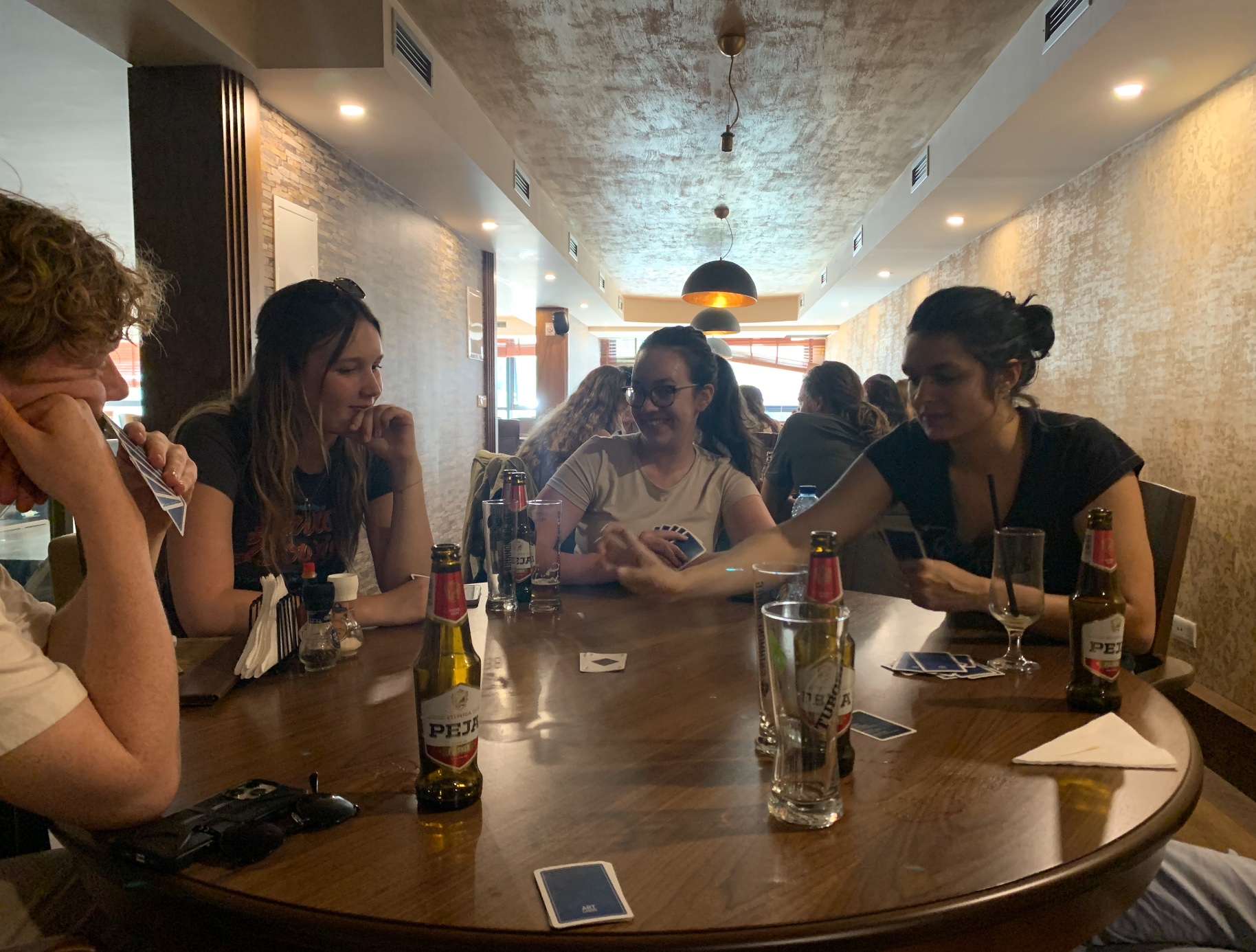
Up next we met with the Global Shapers Pristina group, part of the World Economic Forum. Josie will talk more about this in her blog entry, but I just wanted to mention that, before we started the meeting, one of the people played some beautiful piano songs. The meeting was interesting and afterwards we went for drinks with them at a bar nearby. The table I was seated at mostly played a game called “presidenten”, where I lost a lot until I suddenly found my luck and won for the rest of the games.


The rest of the night brought great food, good music, some drinks, and lots of very interesting conversations, with topics ranging from breast milk to ADHD to existentialism. Overall, I am very happy with how the first two days have been and I am even more excited to see what the coming week has to bring! I hope you all enjoyed reading this - I would be impressed if you made it to the end - and I will talk to you the next time.

Friday, June 16, 2023

Peace Lab Kosovo 2023


By Anne de Graaf


This year we won’t be crossing the bridge. It breaks my heart that this year I cannot show my students a Kosovo that is moving forward—toward peace. It’s a long story that includes a tangled cluster of license plates, elections where hardly anyone voted, mayors who showed up for work, a country asserting its independence, another country and group of countries asserting their power and an endgame leaving everyone guessing. Are we heading for peace? The international perspective includes a narrative now of Kosovo being in the wrong. People here feel frustrated and betrayed.


So where does that leave Peace Lab Kosovo 2023? This is a qualitative research methods fieldwork class. We spent the first week in Amsterdam learning Balkan history. Now I’ve brought 20 AUC students from 14 different countries to learn from people in Kosovo who are watching years of peacebuilding unravel before their own eyes. Many thanks to Peace Lab Rwanda alum Lola Collingbourne who has helped coordinate a terrific program. Peacebuilding, peacemaking, peacekeeping—these are the themes we’re trying to understand better.


We will continue to meet with partners from both Albanian and Serbian communities. Due to the tension and movement of troops we will not travel to the north, but we can zoom with our partners there. We will visit Kosovar-Serbians in the south and hear their perspectives, as well as listen to Kosovar-Albanians in Prishtina and Prizren.


This photo is of the Newborn sign at the heart of Prishtina city center, a monument to Kosovo's declaration of independence in 2008. In social science terms, it's a hidden transcript describing the mood of the country in a language of graffiti. Different (usually unknown) people paint different messages at different times. It once was covered with drawings of bullet holes, which were then painted over with hearts. This year, for the first time, the Newborn word was dismantled, its letters re-arranged and a new word has taken shape. What does it mean?


Please follow our blog as we take this 10-day journey to find the answer to that question and many more, learning from the Kosovar people on the frontlines of peace.

Thursday, August 4, 2022

The voices of the future nation

By Emilie Genvrin


Kosovo became independent in 2008, it is the youngest country in Europe and is not even recognized by all, yet its inhabitants have such a strong voice, so many dreams and hopes for the future of their country. 


For the project I got the opportunity to speak to young Kosovar women as our project was about the voices of young women living in Kosovo. The first thing that stood out to me was the sense of nationality, which was something I had never seen before. Most of the people I spoke to introduced themselves as Albanian Kosovars, even though their entire family had been born in Kosovo for many generations and they had never lived in Albania, and even had a different accent when speaking Albanian. The fact that they said Albanian before saying Kosovar gave it even more importance in my eyes as to me, it meant they felt Albanian before being Kosovar.


It was especially interesting to me as I am first-generation Franco English, but I always present myself as French, even though my mum lived in the UK most of her life and I have an English passport.


However, I quickly realized that even though they did not present themselves as Kosovar in the first place, they still feel a strong love for the country that is theirs. I was told more than once during my interviews that even though life is hard in Kosovo, with not so many opportunities, there was no way that they would live anywhere else. They dream of leaving Kosovo that feels like a prison because of the visa liberalization issue, but only to visit their family in Europe and see America the dreamland, but not to live there. 


Even though they did not present themselves as Kosovar in the first place, they are still hopeful and want to be part of the changes that need to occur in the country. They hope for “a more positive government” that will “actually do what they say.” The young people we interviewed knew a lot about politics, a lot more than most of the French youth know about French politics, for example.


The second thing that stood out to me during this experience was that the people of Kosovo are still hopeful. This happens, despite life not being easy in their country, there not being so many opportunities, salaries being quite low and corruption being a big issue in the country. They have been trying to join the European Union for years and did all that was demanded by the EU, yet nothing is changing. And they still hope for a better future, for positive changes occurring in the country


Not only are the people hopeful, but they are also incredibly kind--open to discussion with strangers, very honest while answering my questions and always answering with sincerity all the questions asked. They did this whether the questions were about the future or the past, positive or negative. They shared with us the places they like, their university, their favourite café, etc. They were always grateful for the interest that we had in the country and touched by it, thanking us for deciding to come to Kosovo and asking questions about our reactions to their country. 


The people of Kosovo make me hopeful for Kosovo, I am now aware more than ever before, that peacebuilding is very hard and that the situation in Kosovo will not be easy to solve, that corruption will not disappear in a day and opportunities arise, but I think that the country, thanks to its people, has a bright future ahead.

Wednesday, August 3, 2022

Soundscapes

By Tanmay Chawla


Good morning Prishtina!


I think Einstein was a bit off with his theory of general relativity. Besides mass and energy, abrupt delight can also bend space and time, I think. We went in to understand a place that was supposed to be haunted by the specter of conflicts past. But going to Kosovo acted as an abrupt stop in the flow of life for the people of Peace Lab. No doubt, the subject matter of our academic gaze was intense and exhausting. Though experientially, we all found a certain type of bliss. In the company of each other, time played tricks on us. By the second night it seemed like we all had known each other for years.


Maybe what we felt was just a bio-social reaction to the shift in our physical environment. Throw a group of barely acquainted people into a radically different environment, their overflowing oxytocin will do the job of enhancing feelings of belonging. Maybe it was because we were away from our usual atomized existence in a late-stage capitalist society. But maybe everyone in the Peace Lab was just nice. And we embodied some vague and idealized notion of home for each other, absent of any internal friction.


For our project I wanted to record sounds, Tal wanted to capture pictures of events and people, and Matt and Finn wanted to interview people in some depth. So we decided to make a collage of pictures, quotes from interviews, and soundscapes. In a very unprofessional manner, I carried around my microphone anywhere and everywhere during our trip. From the sounds of wind and cicadas at the ruins of an ancient Roman town outside of Gracanica, to hour-long conversations with random people on the street who loved Hitler, I thought I recorded everything.


As I said, I am very unprofessional. Generally in life, and as a soundscaper specifically. Hence, I never organized any of the 100+ audio files on my recorder during the trip. When I finally started combing through the files for the project, I realized I had mostly recorded the voices of people in Peace Lab. People who felt like home. Some of it was planned and conscious of course, but I was convinced that I recorded the sounds of “Kosovo” equally as much as the people of Peace Lab, if not more. In reality, I think 90% of any meaningful audio I have is rife with the voices of these beautiful people. And I am grateful for it. They were home for me, if only in a peculiar and bended space-time.


A link to the final version of our project.

It’s desperately missing soundscapes, since our project is called Voices of Kosovo, and not Voices of Peace Lab. Hope you like it.